
EHD-NIRII-640B-U3 in Vivo NIR-II Camera
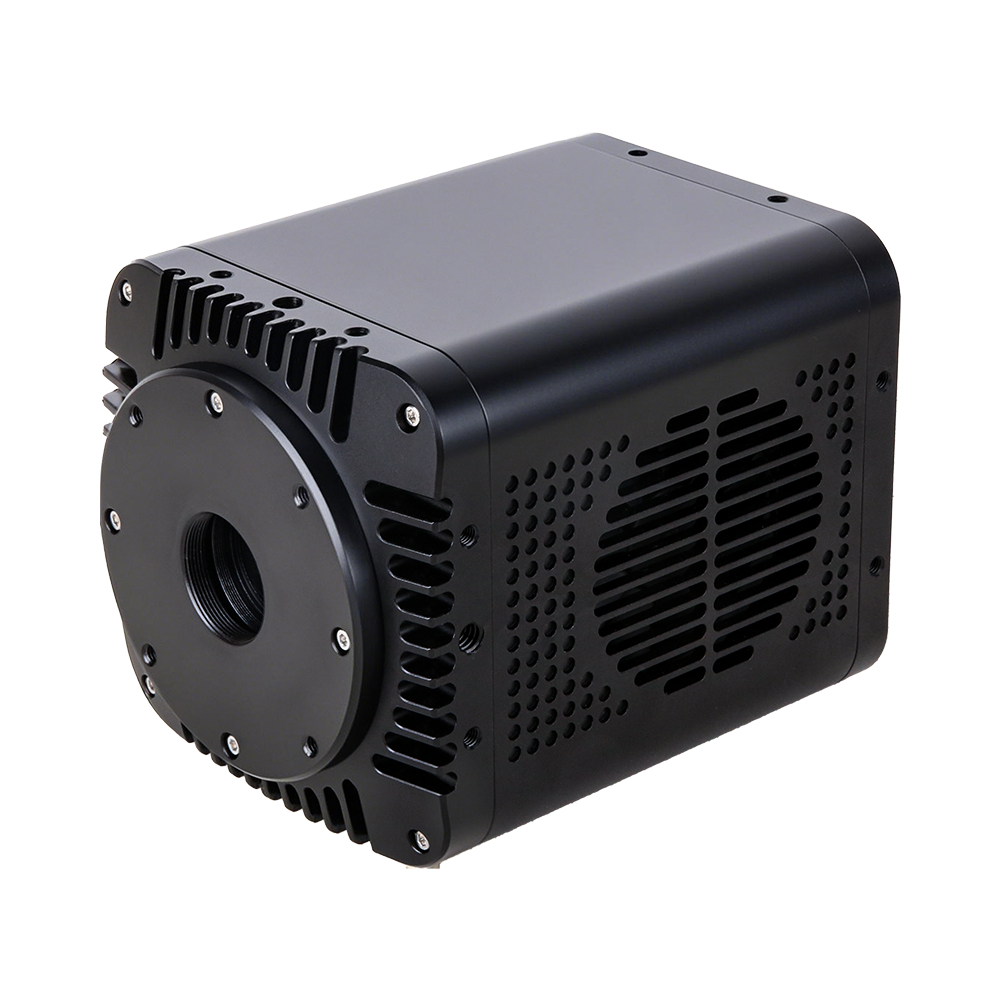
The sNIRII series is designed for cutting-edge scientific applications in the 900–1700 nm (NIR-II) spectral range, utilizing InGaAs image sensors that combine high sensitivity with low readout noise. It is ideal for in vivo near-infrared imaging, biological fluorescence detection, materials/device characterization, and similar scenarios. Typical configurations offer 640 × 512 resolution with 15 µm pixel size, achieving excellent contrast and detail even under low-light conditions.
To suppress dark current and thermal noise, the camera is equipped with TEC cooling and closed-loop temperature control, reducing sensor operating temperature by approximately 40 °C below ambient. Combined with an anti-condensation optical structure, it ensures stable and clean imaging under low-temperature and long-exposure conditions.
The camera provides USB 3.0 and 10GigE (model dependent) high-speed data interfaces, supporting 8/16-bit data output with built-in buffer to guarantee link stability during high-speed acquisition. Acquisition modes include free-running, software/hardware triggering, facilitating synchronization with lasers, light sources, motion/stepper platforms, and other scientific equipment. Bundled with EHDView and cross-platform SDK (Windows/Linux, C/C++/C#/Python) for easy system integration and custom development.
NIR-II Imaging Principles
NIR-II imaging (900–1700 nm) leverages the optical window of biological tissue for deep penetration. Water and hemoglobin absorption is low and scattering diminishes with longer wavelengths, enabling 10–20 mm imaging depth with micron-level resolution. Pairing NIR-II probes unlocks high-contrast angiography, tumor labeling, and lymphatic tracking.
Advantages of InGaAs Sensors
InGaAs (indium gallium arsenide) sensors underpin NIR-II imaging, delivering >80% QE over 900–1700 nm via tunable bandgaps. PIN photodiodes and CTIA readout circuits offer low noise and high sensitivity. Domestic InGaAs advancements provide cost-effective alternatives to formerly exclusive overseas solutions.
Precision Thermal Control and Cooling
sNIRII cameras employ multi-stage TEC (thermoelectric) cooling with Peltier-driven precision control. Integrated heat sinking, closed-loop regulation, and anti-fog design maintain ±0.1 °C stability for extended imaging. Nitrogen-sealed or heated optical windows prevent condensation during low-temperature operation.
Multi-Gain Architecture
An innovative triple-gain architecture toggles capacitor feedback networks to deliver multiple operating modes on one sensor: HCG (0.96 e⁻/DN) for minimal read noise, MCG (5.36 e⁻/DN) for balanced performance, and LCG (2216 ke⁻) for maximum full-well capacity—accommodating applications from single-photon detection to high dynamic range imaging.
System Integration and Software Ecosystem
The sNIRII series ships with a full SDK supporting Windows and Linux. ToupView delivers a visual interface for live preview, parameter tuning, acquisition, and basic analysis. SDKs span C/C++/C#/Python for straightforward integration with LabVIEW, MATLAB, and mainstream imaging libraries via standardized APIs.
In Vivo Vascular Imaging
Harness deep penetration of NIR-II to capture vascular networks 10–20 mm deep. Inject NIR-II dyes like ICG for real-time observation of blood flow, microcirculation, and vascular lesions—vital in cardiovascular research.
Tumor Labeling and Detection
Targeted NIR-II probes label tumors, enabling precise intraoperative margin visualization. Compared with traditional methods, NIR-II offers superior contrast and deeper penetration for more accurate resections.
Lymphatic Tracing
Subcutaneous or peri-tumoral injections of NIR-II tracers allow real-time lymphatic mapping and sentinel node identification—highly valuable in cancer metastasis diagnostics and lymphedema management.
Cerebral Vascular Imaging
NIR-II imaging penetrates skull bone to monitor cerebral vasculature without craniotomy, providing non-invasive, real-time insight into stroke, ischemia, and related conditions.
Semiconductor Inspection
Silicon transparency in NIR-II allows inspection of internal wafer defects, cracks, and impurities. NIR-II penetrates thicker wafers than visible inspection, revealing deeper flaws.
Quantum Dot Fluorescence Imaging
NIR-II quantum dots offer exceptional photostability and quantum yield for long-term in vivo tracking. Surface functionalization enables targeted imaging of specific cells, tissues, or molecules and monitoring of drug delivery.
Delivery Time
2-3 weeks