
Telecentric Lenses
Telecentric lenses are primarily used in industrial image processing because they offer constant magnification regardless of the object distance.
Here are the key reasons for their use:
Freedom of perspective: Unlike conventional lenses, they have no angle of view. This means that objects do not appear smaller when they are further away.
Elimination of parallax errors: There are no measurement errors due to oblique viewing angles. This is essential for the precise measurement of components, as edges are not obscured or distorted.
No change in magnification: If an object moves slightly vertically within the telecentric range (e.g., due to vibrations on a conveyor belt), the image size on the sensor remains the same.
View into deep holes: The parallel beam path allows the lens to look “straight” into holes or recesses, which is impossible with normal (entocentric) lenses due to the perspective distortion of the side walls.
These optics are therefore the standard for metrological applications (metrology) and demanding quality control.
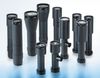
TEC-V & TEC-M Telecentric Megapixel Lenses for 1.1", 1" or 2/3" cameras, 12MP and 5MP
Computar Telecentric High-Performance Lenses: TEC-V & TEC-M Series
Computar telecentric lenses are the ideal solution for precise measurement tasks in industrial image processing. They eliminate perspective errors and ensure that objects are imaged at the same size regardless of their distance from the lens – essential for quality assurance and automated inspection.
TEC-V Series: High resolution for large-format sensors
The TEC-V series was developed specifically for the requirements of state-of-the-art 1.1“ and 1” sensors. With a resolution of up to 12 megapixels, it is the flagship for applications that require maximum detail on large sensor areas.
Maximum precision:
Optimized for pixel sizes from 3.45 µm, ideal for high-end cameras with Sony Pregius sensors.
Versatility:
The series includes both fixed focal lengths and the unique TEC-V7X macro zoom lens, which enables flexible magnification with constant telecentric imaging.
Light intensity & contrast:
Thanks to its high-quality optical design, the TEC-V series from Computar offers excellent light efficiency and minimizes edge shading (vignetting).
TEC-M series: Compact precision for 2/3″ sensors
The TEC-M series is the industry standard for the classic 2/3″ sensor size. It combines a compact design with impressive optical performance of up to 5 megapixels.
Low distortion:
With distortion of almost 0% (less than 0.1% in many models), this series enables highly accurate measurements right into the corners of the image.
Compact design:
Thanks to its slim design, the TEC-M series (via CCTV.net) can be easily integrated into systems with limited installation space.
Optional coaxial illumination:
Many models are available as “MPC” variants with an integrated beam splitter for coaxial illumination, ideal for inspecting highly reflective surfaces such as wafers or metal parts.
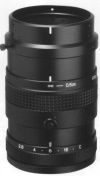
EHD Telecentric Megapixel Lenses Telecentric C-Mount lenses for 4/3" sensors.
Key Specifications of the 5MP Telecentric Series
The 5MP telecentric lenses are designed to handle the rigorous demands of industrial inspection where measurement accuracy is paramount.
Magnification Stability:
These lenses provide a fixed optical magnification (typically 0.5x or 1.0x) that ensures the size of the object remains constant in the image even if the object moves slightly along the optical axis.
Low Distortion:
They feature ultra-low TV distortion, often measured between 0.01% and 0.02%. This is significantly lower than standard lenses, ensuring that the geometric integrity of the object is maintained for precise measurements.
Edge-to-Edge Clarity:
Unlike standard lenses that may lose sharpness at the periphery, these lenses maintain high contrast and resolution from the center all the way to the corners.
Sensor Compatibility:
Optimized for 1″ sensor formats (and below), they are ideal for 5MP cameras with a pixel size of approximately 6μm to 12μm, ensuring the lens can resolve the full detail the sensor is capable of capturing.